40% OFF Festive Season Special β€” Celebrate & Learn with 40% OFF Use code : FEST40 Explore Courses
More Courses πŸ“š
Course Image
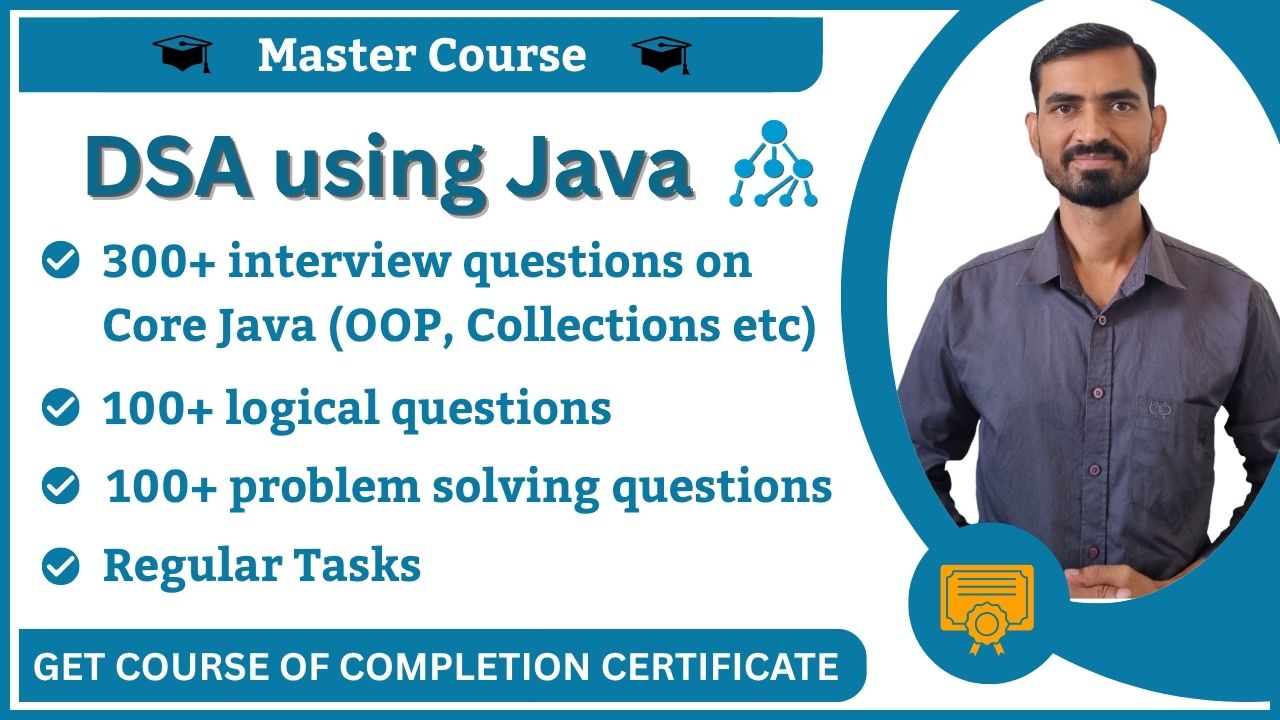
DSA using Java
(Problem Solving)
By Deepak Sir Best Seller
  •   Lectures : 60+
      Price : Rs. 3999   Rs. 8999   56% off
      Rate : 5.0

Login & Buy This Course

DSA using Java (Problem Solving Questions)

Course Introduction :

This DSA Using Java course helps you master all essential Data Structures and Algorithms with a strong focus on problem-solving and interview preparation.
You will learn major data structures like arrays, strings, linked lists, stacks, queues, trees, graphs, heaps, hashmaps, and key algorithms such as two pointers, sliding window, recursion, sorting, searching, greedy, DP, backtracking, and more. The course includes 100+ quality coding questions to boost your logic and confidence.
Perfect for beginners and professionals preparing for placements, internships, and top MNC interviews.

Key Features :

    Industry Level Concepts
    Download Notes & Project Source Code
    100+ Problem Solving Questions
    Mock Interviews & Career Guidance
    Hands-on Coding on LeetCode Problems
    Get Course Completion Certificate
    Learn at Your Pace, Anytime - Anywhere
    Placement Support

Course Content

  • 1.1   DSA Introduction; Types of Data Structures; Use of DSA
  • 1.2   Function Expression [ f(n) ] with Examples
  • 1.3   Simplified Function Expression (Rules); Growth Function Graph
  • 1.4   Asymptotic Notations – Big O, Big Ξ©, Big Θ
  • 1.5   Algorithm Analysis (Time & Space Complexity)

  • 2.1   Array Introduction; Array Memory Concept
  • 2.2   Single Dimensional (1D) Array (Declare, Create & Initialize)
  • 2.3   Array Operations - Part 1 (Traversal, Insertion, Updation)
  • 2.4   Array Operations - Part 2 (Deletion, Searching, Sorting)
  • 2.5   Iterative & Brute Force Approach + Logical Problems
  • 2.6   Iterative Approach Programs (Part 1)
  • 2.7   Iterative Approach Programs (Part 2)
  • 2.8   Brute Force Approach Programs (Part 1)
  • 2.9   Brute Force Approach Programs (Part 2)
  • 2.10   Searching (Binary) & Sorting (Selection, Insertion) Algorithms
  • 2.11   Multi-Dimensional (2D) Array (Declaration, Creation, Initialize & Traverse)
  • 2.12   Matrix Array; Jagged Array; Anonymous Array
  • 2.13   Multi-Dimensional Array Programs
  • 2.14   Higher Dimensional Arrays (3D, 4D, 5D ... Array)

  • 3.1   Two Pointers Technique + Problem Solving Questions
  • 3.2   LeetCode Questions (Part 1) - Same Direction
  • 3.3   LeetCode Questions (Part 2) - Opposite Direction
  • 3.4   LeetCode Questions (Part 3) - Mixed Types

  • 4.1   Sliding Window introduction + Problem Solving Questions
  • 4.2   LeetCode Questions (Part 1) - Fixed Size Sliding Window
  • 4.3   LeetCode Questions (Part 2) - Variable Size

  • 5.1   Kadane's Algorithm (Part 1) + Problem Solving Questions
  • 5.2   Kadane's Algorithm (Part 2) + Problem Solving Questions
  • 5.3   LeetCode Questions (Part 1)
  • 5.4   Circular Array; LeetCode Questions (Part 2)
  • 5.5   LeetCode Questions (Part 3)

  • 6.1   Prefix & Suffix Technique (Part 1)
  • 6.2   XOR (Exclusive OR) + Rules + Logical Questions
  • 6.3   Prefix & Suffix Technique (Part 2)
  • 6.4   LeetCode Questions (Part 1) - Range Sum Problems
  • 6.5   LeetCode Questions (Part 2) - Range Sum Problems 2D Array
  • 6.6   LeetCode Questions (Part 3) - Subarray Sum Problems
  • 6.7   LeetCode Questions (Part 4)

  • 7.1   Infosys Interview Discussion

  • 8.1   String Introduction
  • 8.2   String Constant Pool (SCP); String Object & Immutability
  • 8.3   String Class Constructors & Methods
  • 8.4   StringBuffer & StringBuilder Class
  • 8.5   String Programs (Part 1)
  • 8.6   String Programs (Part 2)
  • 8.7   LeetCode Questions (Part 1)
  • 8.8   LeetCode Questions (Part 2)
  • 8.9   LeetCode Questions (Part 3)
  • 8.10   KMP (Knuth-Morris-Pratt) Algorithm

  • 9.1   Dynamic Array Introduction & Its Working
  • 9.2   Dynamic Array Implementation (Part 1)
  • 9.3   Dynamic Array Implementation (Part 2)
  • 9.4   Dynamic Array (Array List) LeetCode Questions
  • 9.5   Vector Introduction

  • 10.1   Linked List Introduction
  • 10.2   Singly Linked List (SLL) Introduction; SLL Implementation (Part 1)
  • 10.3   Singly Linked List (SLL) Implementation (Part 2)
  • 10.4   Singly Linked List (SLL) Implementation (Part 3)
  • 10.5   Dynamic Linked List (DLL) Introduction; DLL Implementation (Part 1)
  • 10.6   Dynamic Linked List (DLL) Implementation (Part 2)
  • 10.7   Circular Singly Linked List (CSLL) Introduction; CSLL Implementation (Part 1)
  • 10.8   Circular Singly Linked List (CSLL) Implementation (Part 2)
  • 10.9   Circular Doubly Linked List (CDLL) Introduction; CDLL Implementation (Part 1)
  • 10.10   Circular Doubly Linked List (CDLL) Implementation (Part 2)
  • 10.11   LeetCode Questions (Part 1)
  • 10.12   LeetCode Questions (Part 2)
  • 10.13   Fast & Slow Pointers Technique + LeetCode Questions

  • 11.1   Stack Introduction; Stack Implementation in Java Collections
  • 11.2   Stack using Arrays
  • 11.3   Stack using Array List
  • 11.4   Stack using Linked List
  • 11.5   LeetCode Questions (Part 1)
  • 11.6   LeetCode Questions (Part 2)
  • 11.7   Monotonic Stack: LeetCode Questions

  • 12.1   Queue & Simple Queue Implementation
  • 12.2   Circular Queue (Part 1)
  • 12.3   Circular Queue (Part 2)
  • 12.4   Deque - Part 1 (using Circular Array)
  • 12.5   Deque - Part 2 (Task Completed)
  • 12.6   Deque - Part 3 (using Doubly Linked List)
  • 12.7   Priority Queue - Introduction
  • 12.8   Priority Queue - Implementation (Part 1)
  • 12.9   Priority Queue - Implementation (Part 2)
  • 12.10   LeetCode Questions (Part 1)
  • 12.11   LeetCode Questions (Part 2)
  • 12.12   LeetCode Questions (Part 3)

  • 13.1   Map, Entry, HashMap Introduction & Programs
  • 13.2   HashMap Task (Billing System) Part 1
  • 13.3   HashMap Task (Billing System) Part 2
  • 13.4   HashMap Programs - 1
  • 13.5   HashMap Programs - 2
  • 13.6   HashMap Programs - 3
  • 13.7   HashMap Programs - 4
  • 13.8   HashMap Programs - 5
  • 13.9   Set & HashSet
  • 13.10   HashSet Programs
  • 13.11   Hashing Terminologies (Hash Code, Hash Value, Hash Function)
  • 13.12   hashCode() method Deep Explanation
  • 13.13   Hashing technique (Hashing, Compression, Collision Handling)
  • 13.14   LeetCode Questions (Part 1)
  • 13.15   LeetCode Questions (Part 2)

  • 14.1   Recursion Deep Introduction with Programs
  • 14.2   Tail & Non-Tail Recursion (Head & Non-Head) with Programs
  • 14.3   Direct & Indirect Recursion with Programs; Dice Coin Game
  • 14.4   Linear & Tree Recursion
  • 14.5   Recursion Problem Solving Questions

  • 15.1   Tree Introduction; Binary Tree (BT) Introduction
  • 15.2   Binary Tree Implementation (Part 1)
  • 15.3   Binary Tree Implementation (Part 2)
  • 15.4   Binary Tree Traversal (Inorder, Preorder, Postorder)
  • 15.5   Binary Tree Traversal (Level Order)
  • 15.4   Min & Max in BST
  • 15.5   Lowest Common Ancestor (LCA)
  • 15.6   Problem Solving Questions
  • 15.7   AVL (Self Balancing Tree) Introduction
  • 15.8   AVL Rotations
    • Left Rotation
    • Right Rotation
    • LR, RL Rotation
  • 15.9   AVL Tree Implementation
  • 15.10   Rebalancing Process
  • 15.11   Problem Solving Questions

  • 16.1   Trie Introduction
  • 16.2   Prefix Tree
  • 16.3   Trie Implementation
  • 16.4   Applications of Trie
    • Auto-complete
    • Dictionary Search
    • Prefix Matching
  • 16.5   Problem Solving Questions

  • 17.1   Graph Introduction
  • 17.2   Types of Graph
    • Directed Graph
    • Undirected Graph
    • Weighted Graph
    • Unweighted Graph
  • 17.3   Graph Representation
    • Adjacency Matrix
    • Adjacency List
  • 17.4   Graph Traversal Techniques
    • BFS (Breadth First Search)
    • DFS (Depth First Search)
  • 17.5   Graph Implementation
  • 17.6   Problem Solving Questions

  • 18.1   DP Introduction
  • 18.2   Memoization (Top-Down)
  • 18.3   Tabulation (Bottom-Up)
  • 18.4   Problem Solving Questions
Need Help? Whats App or Call Us for Course-Related Queries!
Chat on Whats App      Call us Now  

  Trainer of this course

Deepak Panwar

Deepak Panwar

Software Engineer & Developer / Trainer

I’m Deepak, a Software Engineer with 13+ years of experience in Java Development and DSA Interview Preparation.
I specialize in Java, Data Structures & Algorithms and varioud Java Frameworks.
In my DSA course, you’ll learn from fundamentals to advanced concepts through easy explanations, real questions and practical problem-solving, helping you build strong logic and become interview-ready. Let’s master DSA together! πŸš€

  • 304+ Subscribers on YouTube
  • 22K+ Learners on My Platform
  • 5.0 β˜… Rated Instructor
  • Practical Experience with 50+ Projects
  • Trained 80K+ Students in DSA
  • Live Problem Solving Coding Sessions
  • 13+ Years of Industry Experience
  • Expert in Java Fundamentals & Problem Solving

  Student Reviews

Frequently Asked Questions

This DSA Using Java Course covers all important Data Structures, Algorithms, Coding Patterns and Problem-Solving techniques required for cracking top IT interviews. It includes theory + dry runs + 100+ practice questions.

This course is perfect for:
  • Students preparing for placements
  • Beginners in DSA
  • Java learners
  • Working professionals switching to development
  • Anyone preparing for coding interviews

You will learn Arrays, Strings, Stack, Queue, LinkedList, Trees, BST, Graphs, Heaps, Hashing, Recursion, Backtracking, Dynamic Programming, Sliding Window, Two Pointers, Greedy, and more.

No. This course is made for beginners as well as intermediate learners. Basic Java concepts are explained whenever needed.

You will practice 100+ problem-solving questions, including
  • LeetCode
  • Company-specific coding questions
  • Pattern-based questions for interviews

Yes. The course includes:
  • Interview patterns
  • Problem-solving strategy
  • Dry-run approach
  • Complexity analysis
  • Resume guidance
  • Mock interviews (if required)

Yes. You get:
  • Downloadable notes
  • Topic-wise code files
  • Assignments for practice

Yes, after completing the course, you will receive an official course completion ISO certificate.

Yes. You can contact the instructor directly via WhatsApp or call for doubt resolution.

If you study regularly (2–3 hrs/day), the course takes 2–3 months.
If you study only on weekends, it may take 4–5 months.

Other Suggested Courses

upto 80% discount Get Upto 80% Off on our Professional Courses

Course Image
Java Projects Bundle
(7 Projects)
By Deepak Sir Best Seller
  •   Lectures : 70+
      Price : Rs. 4499   Rs. 9999   55% off
      Rate : 4.8
Course Image
Advance Java
(with 1 projects)
By Deepak Sir
  •   Lectures : 113
      Price : Rs. 2999   Rs. 7999   63% off
      Rate : 4.9
Course Image
Spring Boot Framework
(with 1 project)
By Deepak Sir Best Seller
  •   Lectures : 170
      Price : Rs. 3999   Rs. 8999   56% off
      Rate : 4.8
Course Image
Java Full Stack Development
(7 Projects)
By Deepak Sir Best Seller
  •   Lectures : 530+
      Price : Rs. 6999 Rs. 26999   74% off
      Rate : 4.9